Table of Contents
- ⚡ Key Takeaways at a Glance
- What Is Commercial Solar Battery Storage?
- How Does Commercial Solar Battery Storage Work?
- Why Are Businesses Installing Solar Battery Storage in 2026?
- How Much Money Can Commercial Battery Storage Save?
- What Incentives Are Available for Commercial Battery Storage?
- What Is the ROI and Payback Period?
- How Do You Size a Commercial Battery Storage System?
- Which Industries Benefit Most from Commercial Solar Battery Storage?
- Solar-Only vs. Solar + Battery Storage — Which Is Better for Business?
- What Are the Risks and Limitations?
- How to Choose a Commercial Solar Battery Storage Provider
- FAQs About Commercial Solar Battery Storage
- Conclusion: Is It Time for Your Business to Go Solar + Storage?
📌 Quick Definition: Commercial solar battery storage is a system that stores excess solar power for later use. It helps businesses lower electricity bills, reduce demand charges, and keep critical operations running during outages.
In 2026, solar plus battery storage accounts for 79% of all new U.S. utility-scale capacity — making this the right time for any business to consider upgrading.
⚡ Key Takeaways at a Glance
| What You Want to Know | The Short Answer |
|---|---|
| What does it do? | Stores solar energy so you can use it during peak hours or power outages |
| How much can it save? | Demand charges = 30–70% of a commercial bill; storage can cut this significantly |
| Typical payback period | 5–10 years depending on tariff, incentives, and usage |
| Federal tax incentive | Up to 30% Investment Tax Credit (ITC) when paired with solar |
| U.S. battery storage planned in 2026 | 24.3 GW — showing rapid mainstream adoption |
| Who benefits most? | ~5 million commercial customers may have economic storage opportunities (NREL) |
| LongKun advantage | Factory-direct pricing · Full certifications (CE, UL, IEC, RoHS & more) · Fast lead times · Expert after-sales support |
What Is Commercial Solar Battery Storage?
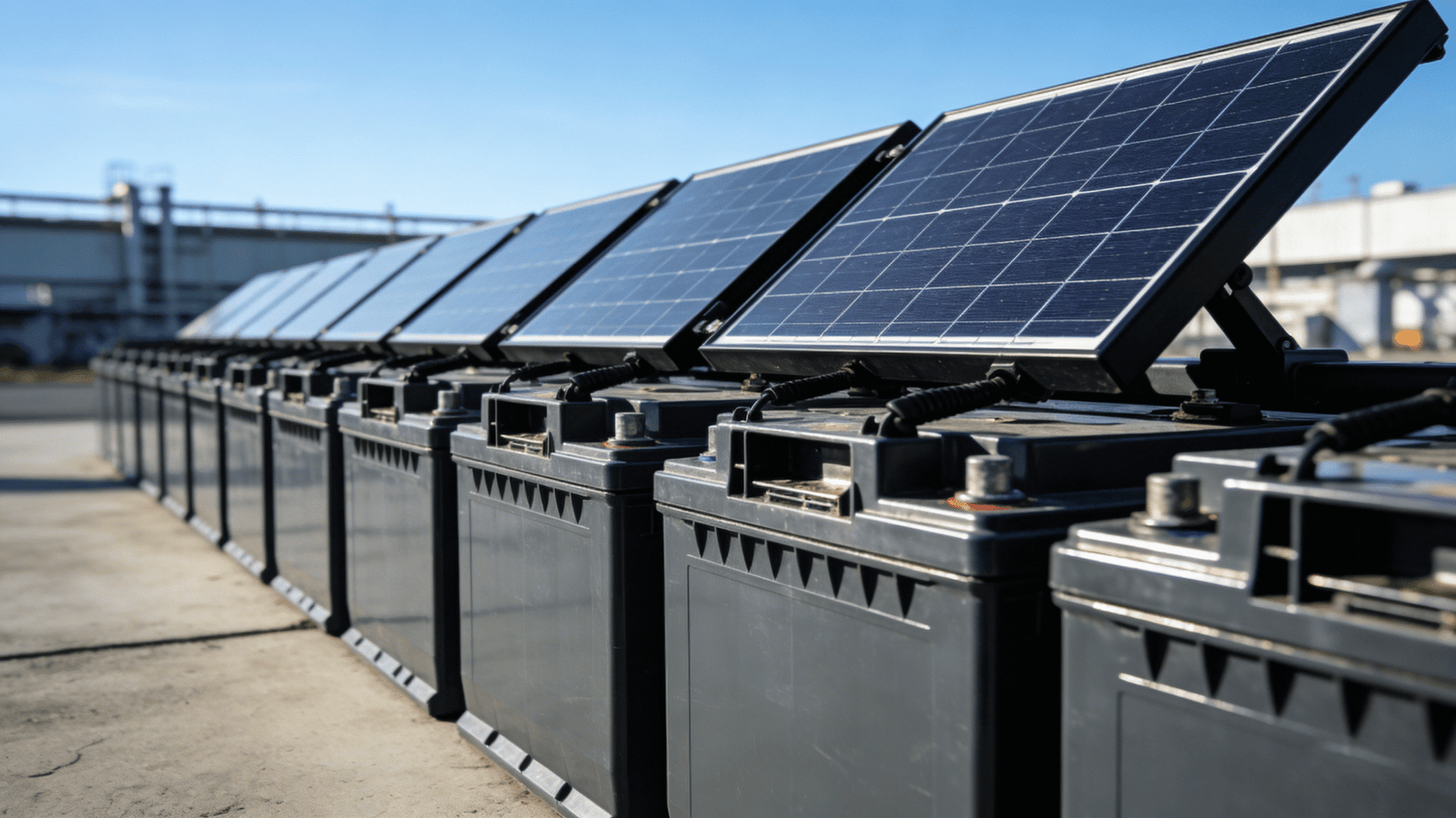
Simply put, commercial solar battery storage is a system that pairs solar panels with rechargeable batteries. During the day, solar panels make electricity. Any extra energy that isn’t used right away gets stored in the battery bank. Later, the business can pull from that stored energy instead of buying from the grid.
This is different from a regular home battery setup. Commercial systems are much larger. They handle higher power loads, tougher operating conditions, and stricter safety requirements. Therefore, they need a higher level of engineering and quality control.
Why Businesses Need It Now
The energy market is changing fast. In 2026, the U.S. is projected to add 43.4 GW of solar and 24.3 GW of battery storage — together making up 79% of all new utility-scale capacity, according to the U.S. Energy Information Administration. Businesses that act now will gain a head start on lower costs and better resilience.
In addition, rising electricity prices and growing sustainability goals are pushing more companies toward energy independence. Commercial solar battery storage is no longer a luxury — it is quickly becoming a smart business investment.
How Does Commercial Solar Battery Storage Work?
The system follows a simple cycle. However, each step involves advanced technology working behind the scenes. Here is how it works, step by step:
- Solar panels generate electricity during daylight hours from sunlight.
- Your building uses what it needs — lights, machines, HVAC, and equipment all run on live solar power.
- Surplus power flows into the battery bank instead of being wasted or exported at low rates.
- The battery stores that energy safely until it is needed.
- During peak hours or outages, the battery discharges and powers your operations.
- The Battery Management System (BMS) monitors everything — temperature, voltage, charge state — to keep the system safe and efficient at all times.
The Role of the BMS
The Battery Management System is the “brain” of the whole setup. It protects the battery from overcharging, overheating, and deep discharge. A smart BMS also extends battery life significantly. Therefore, choosing a system with a high-quality BMS is critical for long-term performance.
At LongKun, we design and customize our own BMS solutions for every commercial project. This means your system is tuned precisely to your business’s energy needs — not a one-size-fits-all solution. You can also learn more about advanced battery technology in our guide on Sodium-Ion vs Lithium-Ion Battery: Which One Is Right for You?
Why Are Businesses Installing Solar Battery Storage in 2026?
Several powerful trends are driving demand right now. First, electricity costs keep rising in most markets. Second, grid reliability is becoming less certain. Third, governments are offering strong financial incentives to speed up clean energy adoption.
| Metric | 2026 Data | Why It Matters for Businesses |
|---|---|---|
| U.S. solar capacity planned | 43.4 GW | Solar costs keep falling — now is a great time to invest |
| U.S. battery storage planned | 24.3 GW | Storage is mainstream, not experimental |
| Share of new U.S. capacity from solar + storage | 79% | The market has already made its decision |
| Installed U.S. storage capacity | Over 40 GW | Proven technology with a deep track record |
| Commercial Q1 2025 solar installations | 486 MWdc | Strong demand signal from the commercial segment |
In addition to cost savings, businesses also install commercial solar battery storage for energy resilience. Outages can cost manufacturers thousands of dollars per hour. Furthermore, data centers, hospitals, and telecom operators simply cannot afford downtime at all.
How Much Money Can Commercial Battery Storage Save?
This is often the first question businesses ask. The answer depends on your tariff structure. However, the biggest savings opportunity for most commercial customers comes from two areas:
1. Demand Charge Reduction (Peak Shaving)
Demand charges are fees that utilities add based on your highest power usage during a billing period — even if it only lasts a few minutes. According to the National Renewable Energy Laboratory (NREL), demand charges can make up 30% to 70% of a commercial electricity bill.
⚡ What is peak shaving? Peak shaving means using your battery to cover short bursts of high energy demand. This keeps your peak usage low — and therefore your demand charges low. It is one of the most financially powerful use cases for commercial storage.
2. Time-of-Use (TOU) Arbitrage
Many utility tariffs charge more for electricity during peak evening hours. Therefore, a business can charge its battery during cheap midday solar hours, then discharge during expensive evening hours. This creates direct savings on every billing cycle.
3. Backup Power Value
For industries like data centers, medical facilities, and manufacturing, even a short outage can cause enormous losses. A battery storage system keeps critical loads running — avoiding costly downtime. This backup value is real, even if it is harder to put a number on it.
NREL estimates that roughly 5 million commercial customers in the U.S. alone may have economically attractive storage opportunities. If your business pays high demand charges, you are almost certainly among them.
What Incentives Are Available for Commercial Battery Storage?
Financial incentives make the numbers work much better. Fortunately, businesses in the U.S. and many other markets can access strong support right now.
Federal Investment Tax Credit (ITC)
When you pair battery storage with a solar system, the system can qualify for a federal Investment Tax Credit of up to 30% of the installed cost. This is a direct reduction in your tax bill — not just a deduction. In addition, certain projects may qualify for bonus adders based on location, domestic content, or energy community status.
“Always confirm current eligibility with a qualified tax advisor before making investment decisions, as incentive rules can change.”
State and Local Programs
Many U.S. states offer additional rebates, grants, or incentive programs on top of the federal ITC. Australia, Europe, and Japan — where LongKun’s key markets are located — also have their own support schemes for commercial clean energy investments.
Utility Demand Response Programs
Some utilities will pay businesses to discharge their batteries during grid stress events. This creates an additional revenue stream on top of bill savings — further improving your overall return.
What Is the ROI and Payback Period?
Most commercial solar battery storage systems are marketed with payback windows of 5 to 10 years. However, actual returns vary based on several factors.
| Factor | Impact on ROI |
|---|---|
| High demand charges | ✅ Strong positive — storage pays back faster |
| Time-of-use pricing | ✅ Strong positive — arbitrage value is high |
| Federal ITC (30%) | ✅ Major boost — cuts net cost by nearly a third |
| Poor battery quality | ❌ Negative — shorter lifespan, higher maintenance costs |
| Oversized or undersized system | ❌ Negative — wasted capital or missed savings |
| Strong after-sales support | ✅ Positive — maximizes uptime and system life |
Simple ROI Example
Imagine a mid-sized warehouse paying $8,000 per month in electricity. Demand charges make up 40% — that is $3,200 per month. A well-sized battery system cuts demand charges by 60%. Therefore, monthly savings come to about $1,920. Over a year, that is $23,040 in savings. After the federal ITC, a $150,000 system net cost drops to around $105,000 — giving a payback of roughly 4.6 years.
Of course, this is just one example. Your actual numbers will depend on your tariff, load profile, and system sizing. This is exactly why working with an experienced battery manufacturer — rather than a generic supplier — makes such a big difference.
How Do You Size a Commercial Battery Storage System?
Sizing is one of the most important steps. Get it wrong, and you either overspend or miss your savings targets. Here are the key factors to consider:
- ✔Peak demand profile — How high do your power spikes go, and how long do they last?
- ✔Daily energy consumption — How many kWh does your facility use in a typical day?
- ✔Solar generation output — How much surplus power does your solar array produce?
- ✔Backup requirements — Which loads must stay on during an outage, and for how long?
- ✔Target savings — Are you optimizing for demand charge reduction, TOU arbitrage, or resilience?
- ✔Future growth — Will your energy needs expand in the next 5 years?
In practice, the best approach is to start with a detailed energy audit. Then build the smallest system that reliably covers your highest-value peaks or critical loads. A good battery partner will help you right-size the system — not oversell you on capacity you don’t need.
For businesses exploring residential-scale comparisons, our detailed guide on Lithium Home Battery Systems also provides helpful baseline context on battery sizing principles.
Which Industries Benefit Most from Commercial Solar Battery Storage?
Almost any business that pays significant electricity bills can benefit. However, certain industries see especially strong returns. Here are the top sectors:
| Industry | Key Benefit | LongKun Experience |
|---|---|---|
| Manufacturing & Warehousing | High demand charge reduction; backup power for production lines | ✅ Proven custom solutions |
| Data Centers | Zero-downtime backup; critical load protection | ✅ Delivered high-capacity packs for data center UPS systems |
| Telecom & Base Stations | Stable long-term power; harsh environment resilience | ✅ Custom high-energy-density packs for major telecom operator |
| Medical Facilities | Critical uptime; lightweight portable power | ✅ Battery packs for portable medical X-ray equipment |
| Retail & Commercial Buildings | TOU arbitrage; demand charge reduction | ✅ Commercial installation projects globally |
| Aerospace & Special Applications | Extreme temperature resistance; mission-critical reliability | ✅ Satellite system battery packs (extreme temp + radiation resistant) |
According to NREL, the opportunity extends broadly — roughly 5 million commercial customers may have economically attractive storage opportunities. This means the benefit is not limited to large industrial sites. In fact, many mid-sized businesses are excellent candidates.
Solar-Only vs. Solar + Battery Storage — Which Is Better for Business?
This is a common question. Both options have merit. However, the answer depends on your business’s specific energy profile and goals.
| Feature | Solar Only | Solar + Battery Storage |
|---|---|---|
| Lower upfront cost | ✔ Yes | Higher initial investment |
| Reduces electricity import costs | ✔ Partially | ✔ Significantly more |
| Reduces demand charges | ✘ No | ✔ Yes — major savings |
| Provides backup power | ✘ No | ✔ Yes |
| Works during grid outage | ✘ No | ✔ Yes |
| TOU energy arbitrage | ✘ No | ✔ Yes |
| Eligible for full ITC benefit | ✔ Yes | ✔ Yes (when paired) |
Bottom line: Solar-only is a good starting point. However, for businesses with high demand charges, critical uptime needs, or ambitious sustainability goals, adding battery storage delivers significantly stronger financial returns and operational resilience.
What Are the Risks and Limitations?
Like any investment, commercial solar battery storage comes with real risks. Understanding them upfront helps you avoid costly mistakes.
Common Risks to Know
- High upfront capital cost — Without incentives, commercial systems can require significant investment. Therefore, financial planning and incentive capture are critical.
- Poor system sizing — An oversized system wastes capital. An undersized one misses savings targets. Proper energy auditing is essential before purchasing.
- Low-quality batteries — Cheap batteries degrade faster, require more maintenance, and create safety risks. Always demand internationally certified products.
- Weak BMS performance — A substandard BMS shortens battery life and can create safety hazards. This is not an area to cut costs.
- Regulatory complexity — Grid connection requirements, fire codes, and permitting rules vary by location. Work with experienced partners who know your local market.
MSDS
IEC
CE
UKCA
RoHS
UL
How to Choose a Commercial Solar Battery Storage Provider
Choosing the right supplier is just as important as choosing the right system. Here is a practical checklist to guide your decision:
- ✔Full international certifications — CE, UL, IEC, RoHS, UN38.3, UKCA. These are non-negotiable for safety and import compliance.
- ✔Customization capability — Can the supplier design a system tailored to your load profile, voltage requirements, and environment?
- ✔Quality of cells used — Tier 1 cells (CATL, BYD) deliver better performance and longer life than generic alternatives.
- ✔Smart BMS solutions — The BMS determines long-term battery performance. Make sure it is field-proven and customizable.
- ✔Factory-direct pricing — Working directly with the manufacturer eliminates distributor markups and reduces your total procurement cost.
- ✔Production capacity and lead time — Can the supplier deliver at your required volume and timeline?
- ✔After-sales engineering support — Who helps you if something goes wrong 3 years from now?
- ✔Track record across industries — Look for proven case studies in sectors similar to yours.
Why LongKun Battery Group? LongKun has served 1,500+ clients across Europe, the USA, Australia, and Japan since 2009. Our 5 fully automated Industry 4.0 production lines and 1,000 skilled employees support an annual output of 50 million+ units. We provide factory-direct pricing, full certifications, fast lead times, and dedicated engineering support from inquiry all the way through after-sales service. Our engineers — some formerly at BYD and CATL — bring world-class technical expertise to every project.
FAQs About Commercial Solar Battery Storage
What is commercial solar battery storage?
Commercial solar battery storage is a system that stores excess electricity from solar panels. Businesses can then use that stored energy during peak-price hours or power outages — rather than buying expensive grid electricity.
How does commercial solar battery storage work?
Solar panels generate power during the day. Any surplus electricity flows into the battery bank. Later, the battery discharges when energy is most expensive or when backup power is needed. A smart BMS manages the whole process safely.
How much money can a business save with battery storage?
The biggest savings come from demand charge reduction. According to NREL, demand charges can make up 30% to 70% of a commercial electricity bill. A well-sized battery system can cut a large portion of this cost every month.
What is peak shaving in commercial battery storage?
Peak shaving means discharging the battery during short spikes of high energy demand. This lowers your peak demand reading — and therefore lowers your demand charges from the utility. It is one of the most financially valuable uses of commercial battery storage.
How long does a commercial battery storage system last?
High-quality lithium battery systems typically last 10 to 15 years, depending on usage patterns, operating environment, and BMS quality. Using Tier 1 cells and a well-designed BMS — as LongKun does — significantly extends system life.
What size battery storage does my business need?
Battery size depends on your peak demand, daily energy consumption, solar generation, and backup requirements. The right size is the smallest system that reliably covers your highest-value peaks or critical loads. A qualified manufacturer can help you right-size the system after a detailed energy audit.
Is commercial solar battery storage worth it?
Yes — especially for businesses with high demand charges, time-of-use pricing, or critical uptime requirements. Most commercial systems have payback periods of 5 to 10 years. Federal incentives of up to 30% can shorten this further.
What incentives are available for commercial battery storage?
In the U.S., commercial projects paired with solar may qualify for a federal Investment Tax Credit (ITC) of up to 30%. Additional bonus adders may apply based on location and domestic content. State and local programs add further support in many regions. Always confirm current eligibility with a tax advisor.
Can battery storage work without solar?
Yes. A standalone battery system can still charge from the grid during low-cost hours and discharge during peak-price hours. However, pairing storage with solar maximizes both savings and incentive eligibility.
Which businesses benefit most from commercial battery storage?
Businesses with high demand charges, time-sensitive operations, or critical power needs benefit most — including manufacturers, warehouses, data centers, telecom operators, medical facilities, and retail sites. NREL estimates roughly 5 million U.S. commercial customers have economically attractive storage opportunities.
Conclusion: Is It Time for Your Business to Go Solar + Storage?
Commercial solar battery storage is no longer a future technology. It is a proven, mainstream business tool. In 2026, solar and storage account for 79% of all new U.S. utility-scale capacity additions. Demand charges make up 30–70% of commercial electricity bills — and batteries can cut deeply into that cost.
The businesses that move first will enjoy the greatest financial advantage. In addition, they will gain operational resilience, sustainability credentials, and energy independence that competitors without storage simply cannot match.
However, the quality of your battery system determines how much you actually save — and for how long. Therefore, choosing a manufacturer with deep engineering expertise, full international certifications, and reliable after-sales support is the most important decision you will make.
At LongKun Battery Group, we have been designing and manufacturing custom battery solutions since 2009. We combine factory-direct pricing with Tier 1 cells, smart BMS technology, fast production lead times, and full compliance with UN38.3, MSDS, IEC, CE, UKCA, RoHS, and UL standards. Whether you need a standard commercial storage solution or a highly specialized system for extreme conditions, our team of 50+ engineers is ready to help.
Ready to Cut Your Energy Bills with Commercial Solar Battery Storage?
Get a fast, no-obligation quote from LongKun’s expert engineering team. We will analyze your energy profile, recommend the right system size, and give you a factory-direct price — with full certification documentation included.
🔋 Request a Free Quote
💬 Talk to Our Engineers
⚙️ Get a Custom Battery Solution
Fast quotation · Strong technical support · Reliable long-term partnership · clkbattery.com
“`