Last updated: 2025 | Reading time: ~10 minutes
⚡ Key Takeaways at a Glance
| Topic | Fast Answer |
|---|---|
| What is an industrial UPS battery system? | A battery-powered backup system that keeps critical equipment running when the grid fails. |
| Global market size (2024) | ~$8.6 billion (industrial UPS); ~$11.5 billion (UPS batteries) |
| Best battery type for industrial UPS | LiFePO4 lithium-ion — longer life, safer, lower total cost |
| Lithium vs. lead-acid lifespan | Lithium: 8–15 yrs | Lead-acid: 3–5 yrs |
| 10-year cost saving (lithium vs. lead-acid) | Up to ~39% lower total cost of ownership |
| Key certifications to look for | UN38.3, IEC, CE, UL, RoHS, UKCA |
| Who can customize industrial UPS batteries? | LongKun Battery Group — custom lithium & LiFePO4 packs with full BMS design |
Power cuts can happen anytime. For a factory, a data center, or a hospital, even a few seconds without power can cost thousands of dollars — or worse. That is exactly why an industrial UPS battery system is so important.
In this guide, we will explain everything you need to know. First, we cover the basics. Then, we go deeper into battery types, sizing, safety, and market trends. Finally, we show you how to pick the right partner for your project.
1. What Is an Industrial UPS Battery System?
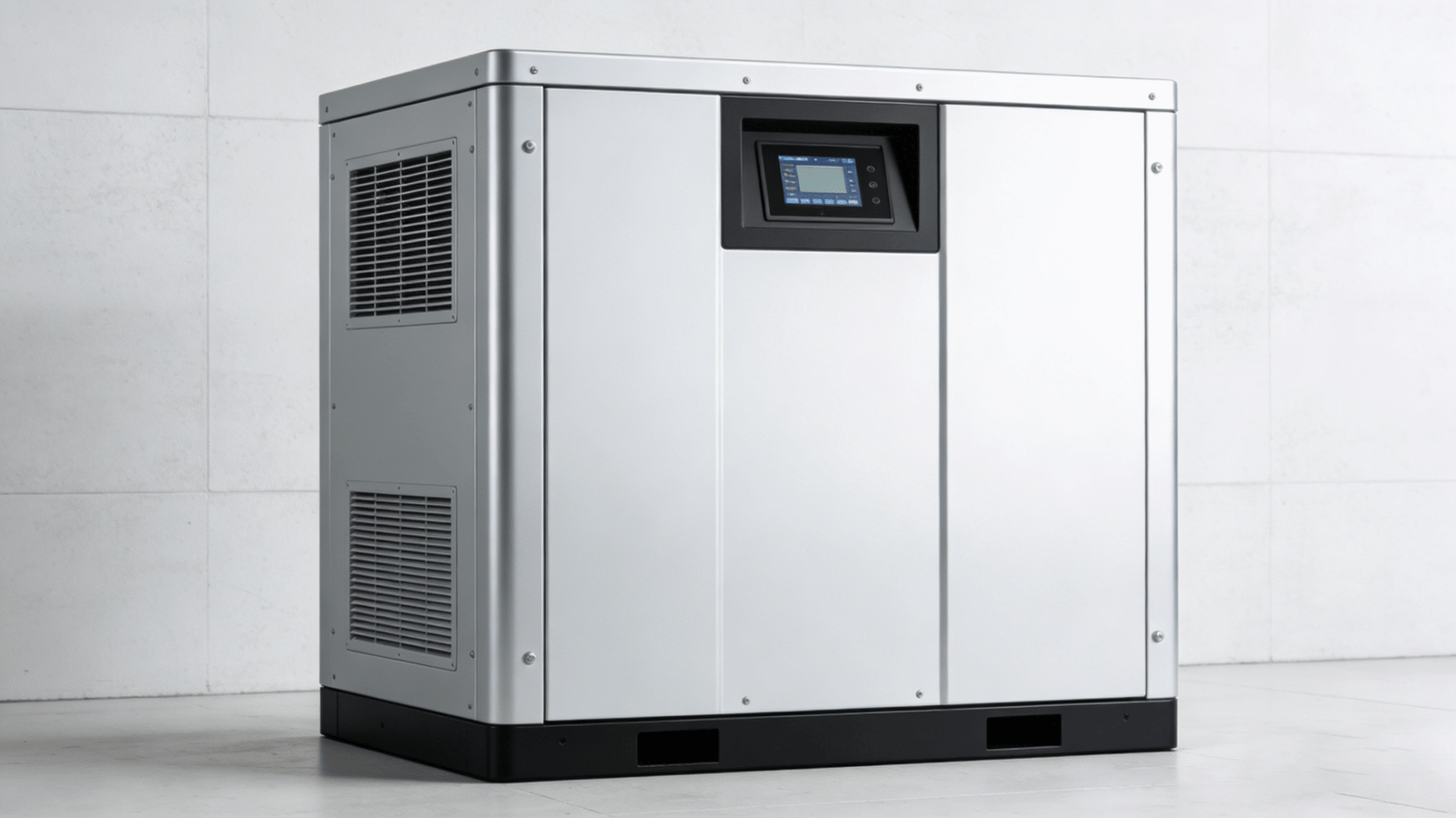
A UPS stands for Uninterruptible Power Supply. An industrial UPS battery system is a backup power solution. It uses batteries and special electronics to keep important industrial equipment running during a power outage or grid problem.
“An industrial UPS battery system is designed for harsh environments and continuous operation — exactly where a simple office UPS would fail.”
Think of it like a giant power bank for a factory. When the main power goes out, the UPS kicks in instantly. There is no gap, no flicker, and no lost data or damaged machines.
Furthermore, industrial UPS systems do more than just provide backup power. They also:
- Filter out voltage spikes and surges
- Regulate frequency to protect sensitive equipment
- Monitor battery health in real time through a Battery Management System (BMS)
- Work reliably in extreme heat, cold, dust, and humidity
2. Why Industrial UPS Systems Matter for Modern Factories and Data Centers
The short answer: downtime is extremely expensive. According to industry research, unplanned downtime in manufacturing can cost over $250,000 per hour. For a data center, that number can be even higher.
Here are the three biggest reasons why industrial UPS battery systems are so critical today:
- They prevent costly downtime. A sudden power loss can shut down an entire production line. A UPS keeps everything running smoothly until backup generators start.
- They protect sensitive equipment. Voltage sags and surges can damage expensive machines, servers, and medical devices. A UPS acts as a protective barrier.
- They maintain safety and process integrity. In oil and gas plants, chemical facilities, and hospitals, a power failure can be dangerous. An industrial UPS keeps safety systems online.
Moreover, the numbers clearly show strong demand:
Global industrial UPS market size in 2024
Market share held by North America
Expected CAGR growth rate
The rise of factory automation and digitalization is driving this growth fast. As more factories adopt smart technology, the need for reliable power backup grows with it.
3. Industrial UPS Market Size and Growth Statistics
The industrial UPS market is growing steadily. Here is a quick overview of the most important market data for 2024 and beyond:
- The industrial UPS market reached around $8.6 billion USD in 2024. North America holds the largest share, with over 40% of the global market.
- The global UPS battery market was valued at about $11.5 billion USD in 2024.
- That battery market is projected to reach roughly $24.8 billion USD by 2030 — a CAGR of approximately 14% from 2025 to 2030.
💡 Why does this matter for you? These numbers show that investing in a quality industrial UPS battery system today is both smart and future-proof. Demand will only grow as industries become more automated and data-driven.
Additionally, the push for cleaner energy and large-scale battery storage power solutions is accelerating the shift toward advanced lithium battery chemistries in industrial UPS applications.
4. Key Industrial Applications of UPS Battery Systems
Industrial UPS battery systems are used across many sectors. Each sector has strict requirements for uptime and power quality. Below are the most common applications:
🏭 Manufacturing & Process Control
🛢️ Oil & Gas Plants
🏥 Healthcare & Laboratories
🚆 Rail & Ports
⚡ Critical Infrastructure
📡 Telecom Base Stations
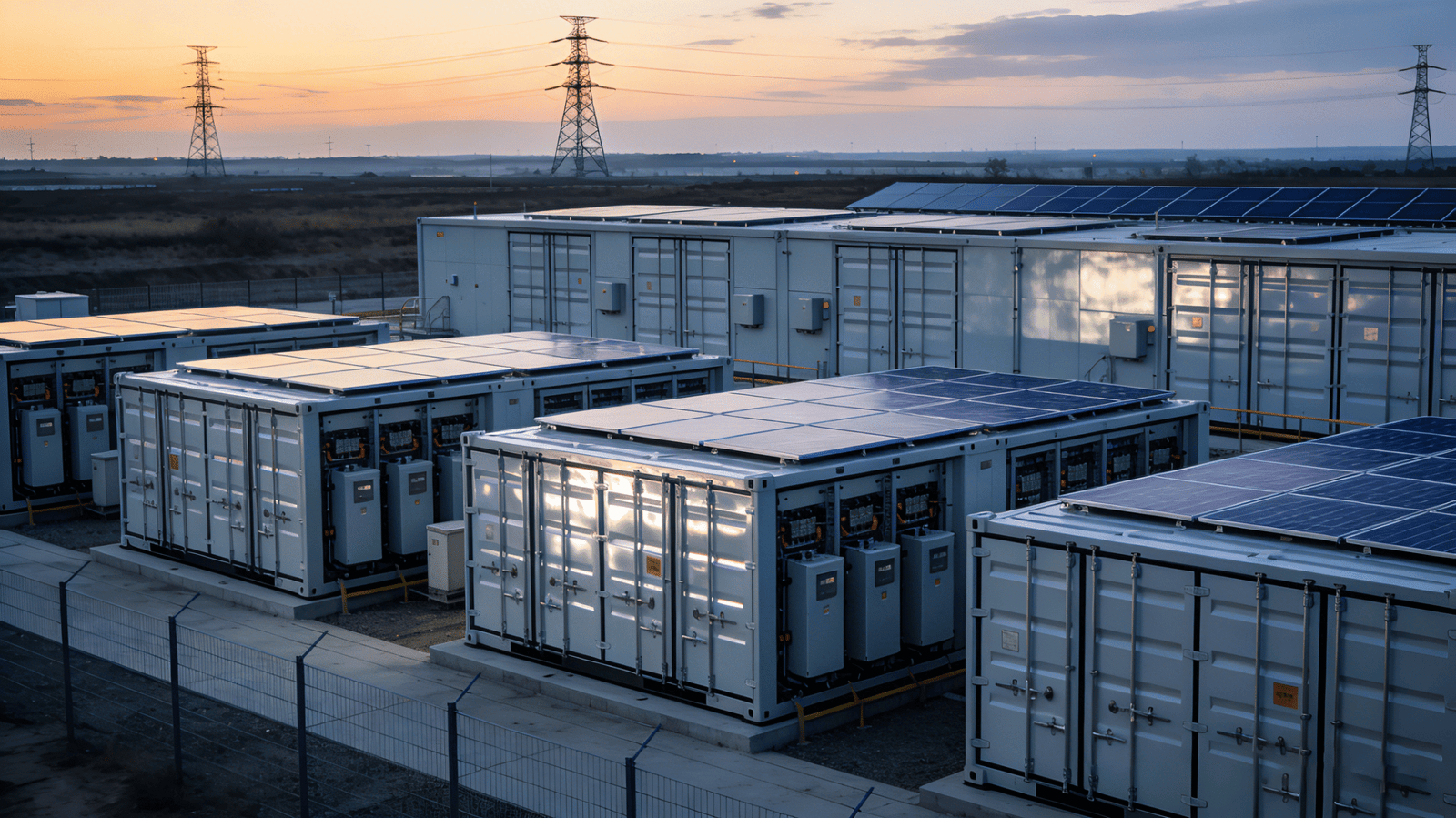
☀️ Energy Storage Systems
Data Centers and IT Rooms
Data centers cannot lose power — not even for a second. Therefore, they rely on industrial UPS systems as the first line of defense before backup generators kick in. Any gap in power could mean lost data or crashed servers.
Manufacturing and Process Control
Modern factories use robotic arms, PLCs, and automated conveyors. These machines need a steady power supply to run safely. An industrial UPS battery system ensures the production line keeps moving even during a short grid interruption.
Oil, Gas, and Petrochemical Plants
In these environments, power failure can lead to dangerous situations. Safety systems, valves, and sensors must stay powered at all times. As a result, industrial UPS systems here must be explosion-proof and rated for extreme conditions.
Healthcare and Laboratories
Hospitals and labs use sensitive equipment like MRI machines, ventilators, and diagnostic tools. A power outage during a medical procedure can be life-threatening. Consequently, UPS systems in healthcare must be the most reliable of all.
Telecom Base Stations
Telecom towers transmit data around the clock. Additionally, they are often located in remote areas with unstable grid power. A high-performance UPS battery system ensures communication never goes down — even during long outages.
5. Lead-Acid vs Lithium-Ion UPS Batteries in Industry
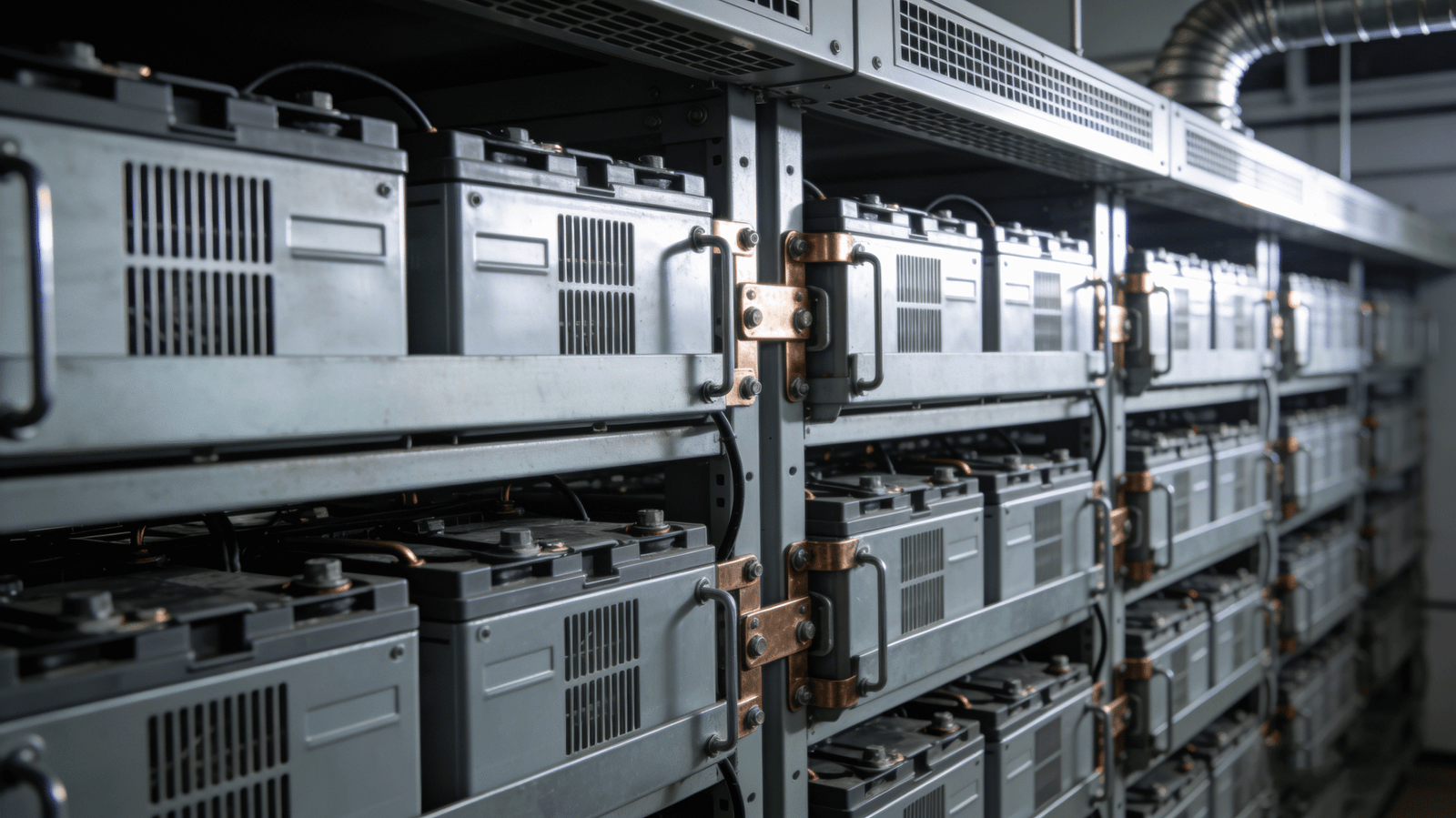
When choosing an industrial UPS battery system, the most important decision is the battery chemistry. Today, the two main options are lead-acid and lithium-ion. Both work, but they are very different in performance, cost, and lifespan.
Lead-Acid Batteries: The Traditional Choice
Lead-acid batteries have been used in UPS systems for decades. They are cheap to buy upfront and easy to recycle. However, they come with important disadvantages:
- Typical lifespan of only 3–5 years
- Heavy and bulky — they take up a lot of floor space
- Need regular maintenance checks
- Slow to recharge — up to 8–16 hours for a full charge
- Lower efficiency at around 80–85%
Lithium-Ion Batteries: The Modern Upgrade
Lithium-ion batteries, especially LiFePO4 (Lithium Iron Phosphate), are quickly replacing lead-acid in industrial UPS applications. They offer major advantages:
- Much longer lifespan: 8–15 years
- Higher efficiency: 95–98%
- Fast recharge: as quick as 1–2 hours
- Lighter and more compact — saves valuable floor space
- Minimal maintenance needed
- Better performance in a wider range of temperatures
6. Technical Comparison: Battery Chemistries for Industrial UPS
The table below gives you a clear, side-by-side comparison. This is exactly the information you need to make the right choice for your industrial UPS battery system.
| Feature | Lead-Acid UPS Battery | Lithium-Ion UPS Battery |
|---|---|---|
| Typical Lifespan | 3–5 years | ✅ 8–15 years |
| Round-Trip Efficiency | 80–85% | ✅ 95–98% |
| Maintenance | Regular checks required | ✅ Minimal |
| Size & Weight | Heavy & bulky | ✅ Compact & lightweight |
| Recharge Time to Full | 8–16 hours | ✅ ~1–2 hours |
| Upfront Cost | ✅ Lower | Higher |
| Total Cost of Ownership (10 yr) | Higher (multiple replacements) | ✅ Up to ~39% lower |
| Temperature Tolerance | Narrow range (20–25°C ideal) | ✅ Wider operating range |
| Depth of Discharge (DoD) | ~50% recommended | ✅ Up to 80–90% |
| BMS Integration | Basic monitoring | ✅ Advanced smart BMS |
“Over a 10-year period, lithium-ion UPS batteries can reduce total cost of ownership by up to approximately 39% compared with lead-acid in data center and industrial deployments.”
7. Why LiFePO4 Is Winning in Industrial UPS Applications
Among all lithium chemistries, LiFePO4 (Lithium Iron Phosphate) is the top choice for industrial UPS systems. But why? Let us break it down simply.
- Safety first. LiFePO4 is the most thermally stable lithium chemistry. It is far less likely to overheat or catch fire — a crucial factor in industrial settings where safety is non-negotiable.
- Exceptional cycle life. A quality LiFePO4 cell can handle 3,000–5,000 charge cycles before it degrades significantly. That easily matches a 10–15 year UPS lifespan.
- Wide temperature range. LiFePO4 batteries work reliably from as low as -20°C up to 60°C. This makes them suitable for outdoor telecom stations, factories, and cold storage facilities.
- Lower total cost over time. Even though the initial price is higher, LiFePO4 batteries last so much longer. Therefore, they save money in the long run — up to 39% lower TCO over a decade.
- Eco-friendly. LiFePO4 does not contain toxic heavy metals like cobalt. Additionally, it is fully RoHS compliant, which is important for global deployments.
🔋 Typical LiFePO4 UPS Module Specs (Example — LongKun):
Nominal Voltage: 12.8V | Capacity: 100Ah | Cycle Life: ~4,000 cycles | Operating Temp: -20°C to 60°C | Certifications: CE, UL, MSDS, RoHS, UN38.3
For applications that also need to store renewable energy alongside UPS backup, LiFePO4 is an equally strong choice. See how it fits into broader
residential energy storage and
commercial battery storage power plant systems.
8. How to Size an Industrial UPS Battery System (Simplified Steps)
Sizing an industrial UPS battery system correctly is very important. Too small and your equipment loses power too quickly. Too large and you waste money. Here is a simplified step-by-step process:
Define your critical load (kW or kVA). List every piece of equipment that must stay powered during an outage. Add up their total power draw. Always add a safety margin of around 20–25% for future expansion.
Decide your backup runtime. How long do you need the UPS to run? Common choices are 10 minutes (until a generator starts), 30 minutes, or several hours for critical facilities.
Consider power factor and inrush currents. Some motors and equipment draw a large current surge at startup. Your UPS must handle these peaks without tripping.
Choose your battery chemistry. Compare lead-acid vs. lithium based on your environment, space, budget, and lifecycle cost requirements.
Calculate required battery capacity in Ampere-hours (Ah). Use this formula:
Ah = (Load in Watts × Runtime in hours) ÷ DC Bus Voltage × Derating FactorThe derating factor accounts for temperature and battery aging (typically 0.8–0.85).
Work with a qualified supplier. A specialist like LongKun Battery Group provides engineering support, sizing tools, and custom BMS solutions to make this process accurate and straightforward.
9. Environmental and Safety Considerations (Temperature, Ventilation, Standards)
Safety is the most critical factor in any industrial UPS battery system. Improper installation or poor quality batteries can cause fires, equipment damage, or even injuries. Here is what you must consider:
Temperature Management
Lead-acid batteries perform best at around 20–25°C. For every 10°C above this range, their lifespan can roughly be cut in half. LiFePO4 lithium batteries, on the other hand, tolerate a much wider range — typically -20°C to 60°C — making them more suitable for challenging industrial environments.
Ventilation and Fire Protection
- Battery rooms must have adequate ventilation to remove heat and any off-gases.
- Install fire suppression systems appropriate for the battery chemistry used.
- Keep batteries away from flammable materials and direct sunlight.
- Use smoke and temperature sensors for early warning.
Battery Management System (BMS)
A smart BMS is non-negotiable for modern industrial UPS battery systems. It continuously monitors cell voltage, current, temperature, and state of charge. Moreover, it prevents overcharging, deep discharge, and thermal runaway — keeping the system safe around the clock.
Key Certifications to Look For
Always verify that your industrial UPS battery system carries these important certifications:
IEC
CE
UKCA
UL
RoHS
MSDS
10. From Lead-Acid to Lithium: Retrofit Trends in Industrial UPS
Across the world, businesses are upgrading their existing UPS systems. Specifically, they are replacing old lead-acid battery strings with modern lithium-ion packs. This trend is accelerating for several key reasons:
- Space savings. Lithium batteries are significantly smaller and lighter. Therefore, retrofitting frees up valuable floor space in battery rooms and data halls.
- Longer replacement intervals. Instead of replacing lead-acid batteries every 3–5 years, lithium batteries can last 8–15 years. This dramatically reduces maintenance disruptions.
- Lower total cost of ownership. Over a 10-year period, switching to lithium can save up to ~39% in total costs when compared to lead-acid. This includes battery replacements, labor, and energy efficiency gains.
- Grid compatibility. Modern lithium UPS batteries integrate easily with smart energy management systems. Furthermore, they can also support broader energy storage goals alongside solar panels and other renewable energy sources.
- Regulatory and ESG pressure. More companies are under pressure to reduce their environmental footprint. Lithium batteries — especially RoHS-compliant LiFePO4 — align with green manufacturing and corporate sustainability goals.
♻️ Did you know? Many industrial facilities are now combining UPS battery systems with on-site solar energy storage. This creates a hybrid power strategy that reduces both downtime risk and energy costs. Explore how this works with our
battery storage power plant solutions.
11. How LongKun Battery Group Supports Industrial UPS Projects
Founded in Shenzhen in 2009, LongKun Battery Group is a professional, one-stop custom battery pack manufacturer. We specialize in designing and building high-performance batteries for some of the world’s most demanding applications — including industrial UPS systems.
What Sets LongKun Apart?
- Full custom design service. Our team handles everything — from cell selection and structural design to BMS customization and final pack assembly. You get a battery system built exactly for your UPS requirements.
- Tier-1 cells. We use advanced cells from top-tier brands to ensure high energy density, fast charging, and long cycle life in every industrial UPS battery pack we produce.
- Industry 4.0 factory. Our factory runs 5 fully automated production lines with strict quality control at every step. Additionally, we have over 50 experienced engineers — some with backgrounds from BYD and CATL.
- Proven scale. Over 50 million units produced annually. More than 1,500 satisfied clients worldwide. Our primary markets include Europe, the USA, Australia, and Japan.
- Full certification portfolio. All our batteries carry the certifications global industrial buyers require:
MSDS
IEC
CE
UKCA
RoHS
UL
Real-World Case Studies
Our experience with demanding battery projects translates directly into superior industrial UPS solutions. Here are some examples of what we have delivered:
- Commercial Data Center Backup: A multinational corporation chose LongKun to supply battery packs for their data center backup systems. Our high-capacity, long-lasting packs kept the centers running through multiple grid outages — protecting mission-critical operations.
- Telecom Base Station: A major telecom company needed batteries for remote base stations. We designed a high-energy-density pack with excellent resistance to harsh environments. The result: stable communication power with significantly reduced interruption risk.
- Aerospace & Special Environments: We developed battery packs for satellite systems that had to withstand extreme temperatures and radiation. This kind of engineering expertise feeds directly into our explosion-proof and high/low-temperature UPS battery capabilities.
- Medical Equipment: We built lightweight, high-capacity battery packs for portable X-ray machines — combining fast charging with extended runtime. These same qualities are equally valuable in medical facility UPS applications.
Whether you need a standard industrial UPS battery replacement or a fully custom LiFePO4 battery system, LongKun has the engineering team, manufacturing capacity, and certification portfolio to deliver. You can also explore our
residential energy storage battery solutions for smaller-scale or hybrid residential-industrial projects.
FAQs About Industrial UPS Battery Systems
Here are the most common questions people ask about industrial UPS battery systems — answered simply and clearly.
Conclusion
An industrial UPS battery system is no longer just a nice-to-have — it is essential infrastructure for any modern factory, data center, hospital, or critical facility. Power outages happen. The question is whether your business is ready for them.
As we have seen throughout this guide, lithium-ion and LiFePO4 batteries are rapidly becoming the gold standard for industrial UPS applications. They last longer, cost less over time, charge faster, and take up less space. Furthermore, the global market is growing fast — reaching nearly $25 billion by 2030 — which means now is the perfect time to upgrade or invest in a quality system.
Choosing the right battery partner is just as important as choosing the right chemistry. You need a manufacturer with proven engineering expertise, global certifications, and the flexibility to customize a solution for your exact requirements.
Ready to Power Your Industrial UPS System with Confidence?
LongKun Battery Group has been building custom lithium and LiFePO4 battery solutions since 2009. With 50+ engineers, 5 automated production lines, and certifications for global markets — we are ready to support your industrial UPS project from design to delivery.
🔋 Let us build the right battery for your application — on time, on spec, and backed by real engineering expertise.